U.S. President Donald Trump on Thursday offered his “total endorsement” of Japanese Prime Minister Sanae Takaichi ahead of Sunday’s national election, saying he looked forward to welcoming her to the White House next month.
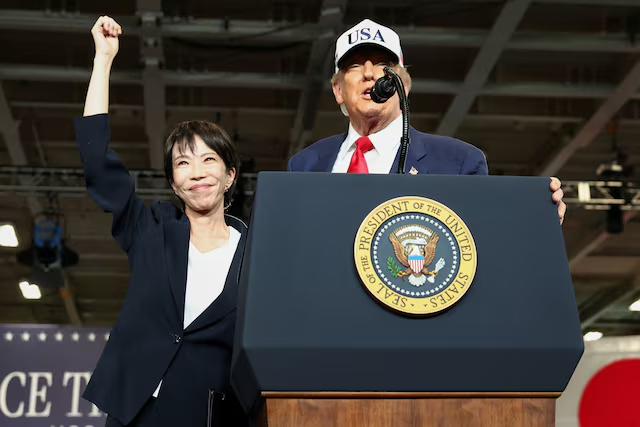
Japan’s first female prime minister, a conservative who has cited Britain’s former leader Margaret Thatcher — known as the “Iron Lady” — as an inspiration, is widely expected to secure a decisive victory for her ruling coalition, opinion polls show. Takaichi is seeking voter backing for ambitious spending proposals that have unsettled investors, as well as for a defence expansion that could further heighten tensions with China.
Opinion polls indicate that Prime Minister Sanae Takaichi’s Liberal Democratic Party (LDP), together with its coalition partner the Japan Innovation Party (Ishin), is on track to win roughly 300 seats in Japan’s 465-member lower house of parliament — a sharp increase from the narrow majority the ruling bloc currently holds.
Trump’s Endorsement Gives Takaichi a Boost
U.S. President Donald Trump publicly backed Takaichi on Thursday, calling her leadership worthy of “powerful recognition” in a post on his Truth Social platform.
“Prime Minister Takaichi is someone who deserves powerful recognition for the job she and her coalition are doing,” Trump wrote. “It is my honor to give a complete and total endorsement of her and what her highly respected coalition represents.”
Analysts note that Trump’s support could provide a political tailwind for Takaichi, 64, a nationalist leader known for her hawkish defence stance. Unlike previous U.S. presidents, Trump has increasingly sought to influence foreign elections, and his endorsement of Japan’s prime minister reflects a broader trend of aligning with right-wing leaders overseas, particularly those advocating stronger military and national security policies.
On Thursday, he endorsed Hungarian Prime Minister Viktor Orban for a vote there in April and last year backed Argentine President Javier Milei, highlighting U.S. financial support as a factor in Milei’s 2025 legislative success.
Even though Takaichi already appears poised for a commanding victory, Trump’s endorsement will resonate in Japan, Asuka Tatebayashi, a geopolitical analyst at Mizuho Bank said.
“From the perspective of the business community, improved relations and better recognition by Trump will be seen as a positive,” Tatebayashi said. “And even amongst the general population, Trump is surprisingly popular in Japan compared to some western countries.”
Japanese government spokesman Kei Sato declined to comment on Trump’s endorsement but confirmed that Trump had invited Takaichi to visit Washington on March 19.
“Amid a rapidly changing international situation, the visit is expected to provide an opportunity to reaffirm the unwavering bonds of the Japan–U.S. alliance,” Sato told a regular press conference.
One of Takaichi’s first engagements after she was elevated to prime minister in October was to host Trump in Tokyo.
She gave him a putter used by his former golfing buddy, the late Japanese Prime Minister Shinzo Abe. Lauded by Trump for breaking Japan’s glass ceiling, Takaichi pledged billions of dollars in investments in a meeting analysts said helped underline the strength of the Japan-U.S. alliance.
CHALLENGES WITH CHINA, JITTERY MARKETS
Weeks later, however, she touched off the biggest diplomatic dispute with China in over a decade by publicly outlining how Tokyo might respond to a Chinese attack on Taiwan.
Trump, who is seeking to maintain a fragile trade truce with China, asked Takaichi in a private phone call in November not to further aggravate Beijing, sources told Reuters.
A decisive election victory could strengthen Prime Minister Sanae Takaichi’s hand in ongoing tensions with China, according to current and former Japanese officials, although Beijing has shown little sign of softening its stance.
Takaichi’s push to bolster Japan’s national defence is also expected to provoke further criticism from China, which has accused her government of reviving elements of Japan’s pre-war militarism. Despite the diplomatic dispute beginning to weigh on Japan’s economy — the world’s fourth largest — Takaichi’s approval ratings remain high.
The prime minister has even emerged as an unexpected cultural figure among voters, with supporters snapping up items she uses publicly, including the handbag she carries and the pink pen she uses during parliamentary sessions.
Financial markets, however, have grown increasingly wary of Takaichi’s economic agenda. Her campaign pledge to ease cost-of-living pressures by suspending Japan’s sales tax on food has unsettled investors in a country carrying the world’s heaviest public debt burden.
In recent weeks, concerns over how the government would fund an estimated 5 trillion yen ($30 billion) annual revenue shortfall have triggered sell-offs in Japanese government bonds and pushed the yen into sharp volatility.
Still, analysts say a commanding win for the ruling Liberal Democratic Party (LDP) — which has dominated Japanese politics for much of the post-war period — may ultimately prove the least disruptive outcome for financial markets, particularly as opposition parties are proposing even steeper tax cuts and broader spending plans.
Sunday’s election result could hinge on voter turnout among younger supporters, who back Takaichi in large numbers but traditionally vote at lower rates than older generations. Unusually heavy snowfall across parts of Japan may also dampen participation.
Takaichi has said she would step down as prime minister if the polls prove wrong and she fails to retain a parliamentary majority.